

Indigenous American Artists Illustrate Their Perspectives from “Between Two Worlds”
By Rosa Morales-Simmons

A portrait of two people with two middle fingers raised stands in Indigenous American clothing at the foreground of the darkened copy of the Indian Removal Act of 1830. The Scott Strong Hawk Foster photograph is on display at the South End’s ShowUp gallery’s “Between Two Worlds: Making Sense of Modern Life from Indigenous” exhibition.
“My ethos as an Indigenous photographer is to represent my family, and my community authentically,” said Foster.
The photographer's collection shared the art-decorated space with five other Indigenous artists whose work by pen, paint, digital tools, and pyrography on birch wood illustrated their views of the present world, while rooted in their perspectives as first nation people. The gallery’s theme emphasized a reminder of the “still here” refrain in reference to post-North American colonialism, ethnic cleansing and genocide.
“There's a bigger conversation to be had. And that's what we are doing with ourselves now that we're here? I think Indigenous people in general are very resilient and adaptive,” said show curator and Native American painter, Nayana Lafond. “I wanted to show what it's like to walk between worlds.”
Photography by Scott Strong Hawk Foster viewed in an exclusive room of the gallery intended to reveal the truths of past and present Native American culture and heritage. The Hassanamisco Nipmuc photographer centers diverse first nation tribes across New England to challenge widely misunderstood, or deliberately harmful concepts.

“The idea of walking between worlds is sort of coexisting in the modern world," said Lafond. ”The tradition of bringing them together, and trying to find your way through life in this modern society, is somebody who has so much involvement in traditional belief systems and practices.”
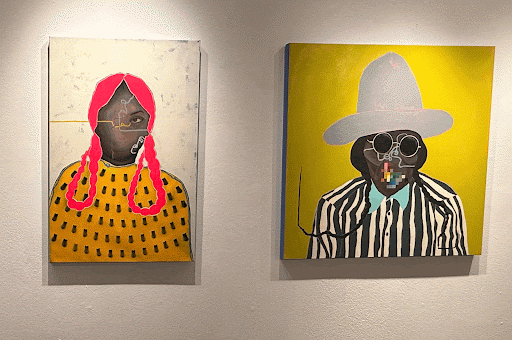
Hunkpapa Lakota artist/author, and citizen of the Standing Rock Sioux tribal nation, Danielle SeeWalker, uses multidisciplinary art to update outdated perceptions in the current century. SeeWalker’s paintings object to the silencing of Native nations’ history, while offsetting prevailing, reductionist views from outsiders.
“I love creating imagery of Native Americans in the present. You’re never going to see me creating an image of a Native with a headdress on a horse,” said SeeWalker.
“We're a present people. We're also not a monolith – I think it's important for people to start seeing Indigenous people as present and current and relevant to current topics and ideas,” said Lafond.

Arizona native Allison Begay’s education in lithography and Navajo heritage influenced an interpretation of nature and technology. The abstract tribal style meshed among the other contemporary works is a conception of digital tools and traditional paints that are meant to be pictorial of the two worlds.

Massachusetts’ Ojibwe artist Hailey-Jade Araujo paintings are intended as advocates for education of Native ancestral cultures and the propellant for the progressive understanding of them. Araujo’s exploration of the complexities of her history is explicable in her use of paint and symbolism.


Multimedia artist and member of the Chaubunagungamaug band of Nipmuck in Massachusetts, Sierra Autumn Henries, free-hands her design work on birch wood using a burning tool in a process known as pyrography. The direct use of raw materials implicates Henries’ intentions to make contact with nature, while inspiring viewers to do the same.

“Historically we've been put into the basement a lot. We've been relegated to the past, to artifacts,” said LaFond.
Apsáalooke (The Crow) and Northern Cheyenne artist, Carlin Bear Don’t Walk from Busby, Montana presented his experience on a Reservation with bright and contrasting tones and pigments. His explicit interpretation of the disadvantaged lifestyles drew viewers like a center piece.
“I want to represent for my community and be their voice, to tell their story in a way nobody has done it before. I create with the intent to uplift those in need, to build my community up with positivity through expression, action and demonstration,” said Carlin Bear Don’t Walk.


“His work really says a lot about the current political situation that we're in. And not just from the Indigenous perspective” Lafond said. “This is the reality of what it is like to live on a reservation. This is the reality of what this feels like from a broader perspective of being an American, right now and feeling uncertain and unclear and, you know, unsafe feeling.”
LaFond notes an elevation in Indigenous representation from fashion designers to performance artists in the contemporary scene. In 2024, some industry professionals foresaw an increase in demand for Native-sourced art from Indigenous communities globally.
“I think there's been a huge shift, and it needs to continue, " she said.


Comments